Astrid Séville: The language of democracy

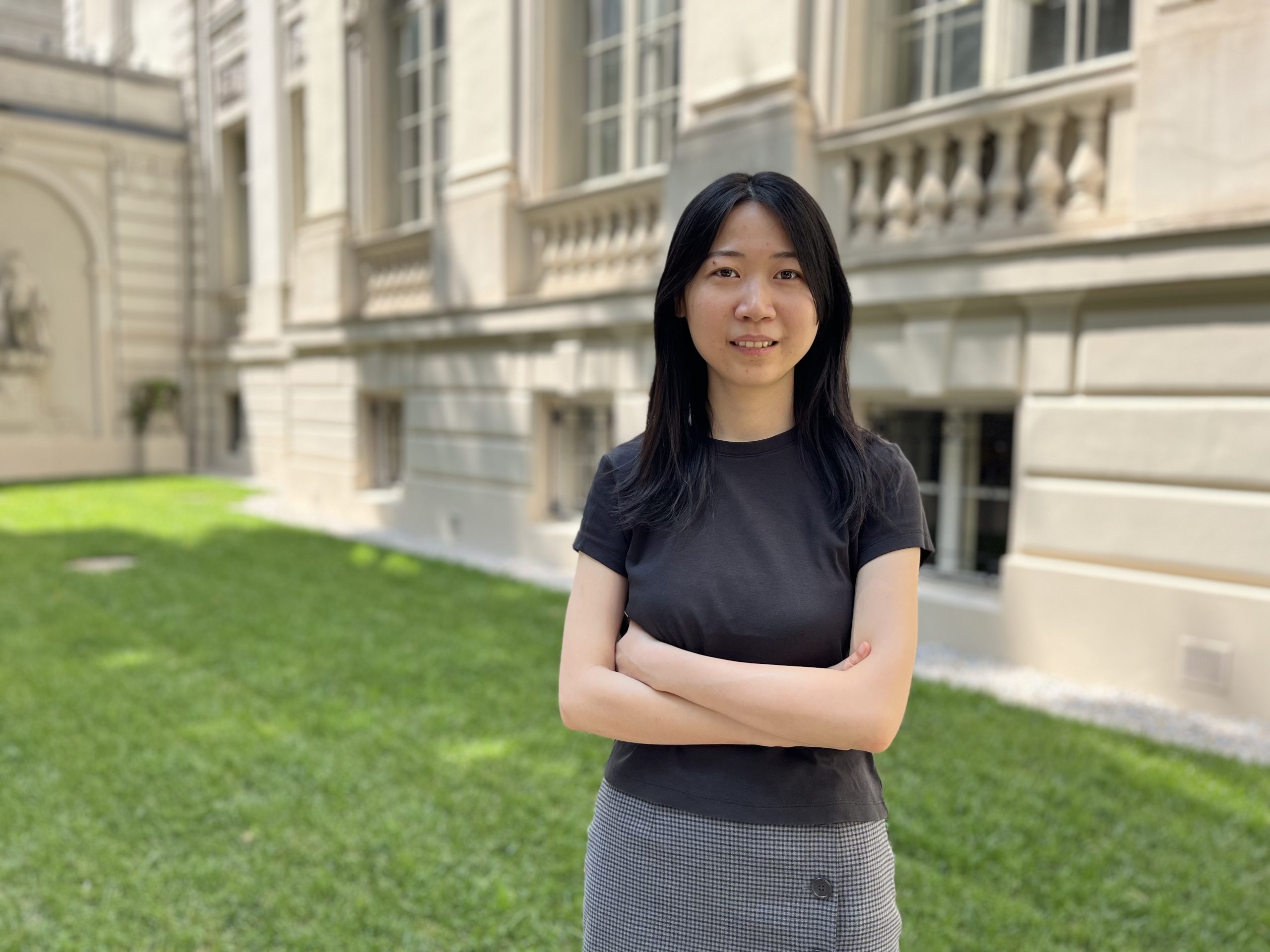
In times of multiple crises, science communication is under pressure: it is supposed to provide guidance, yet at the same time it itself becomes the subject of mistrust. This is precisely where Astrid Séville, political scientist and speaker at the Vienna Lecture on Science Communication 2026, comes in.
An introduction by Chiara Joos
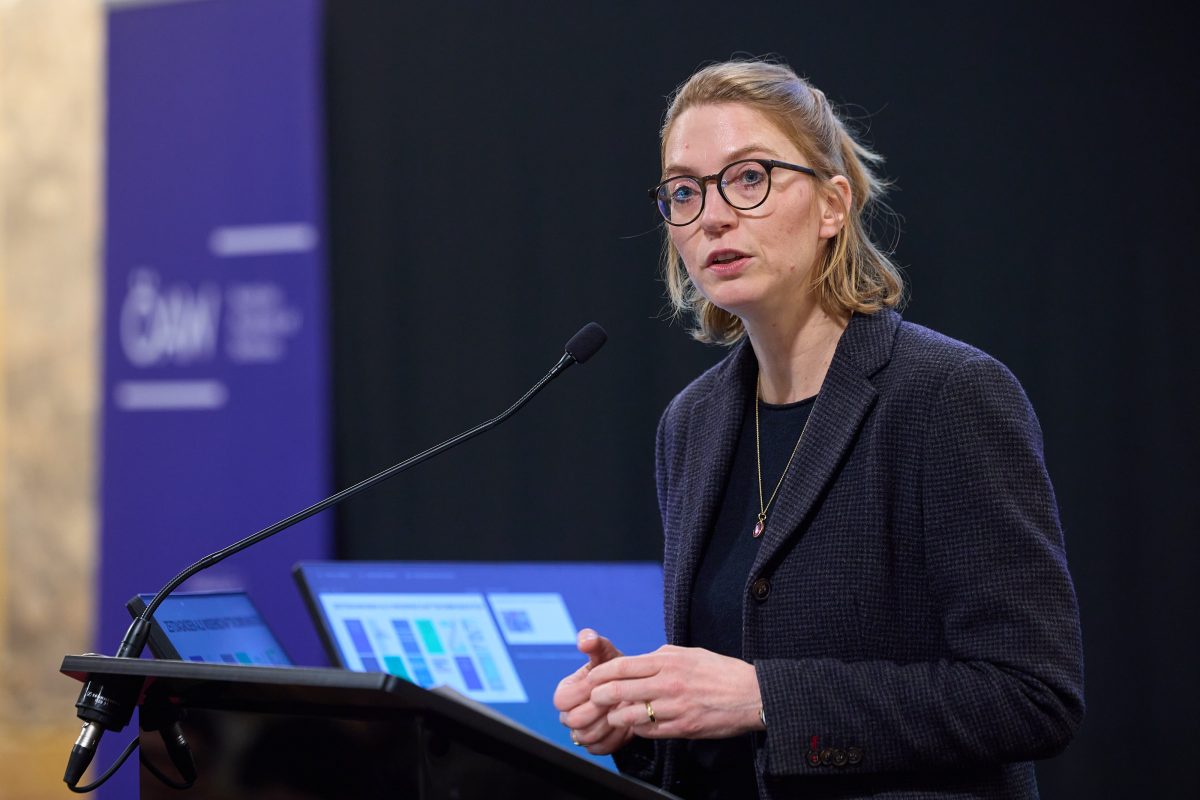
More than a hundred people have come to Lüneburg to listen to Astrid Séville talk about new heroism. But she begins with Heidschnucken sheep. These sheep are the symbol of the region in northern Germany between Hamburg and Hanover. “Students here are also called that among us professors,” jokes Séville, proudly pointing out that the systems theorist Niklas Luhmann was born in this research-intensive city.
Since October 2023, the 41-year-old native of Aachen has been a professor of political theory at Leuphana University and heads the Center for Democracy Research. After studying in Paris and Freiburg and working at the Technical University of Munich and Vienna, she is now addressing a question that runs through her work: What does political language reveal about the self-image of its actors?
In Vienna, as Sir Peter Ustinov Visiting Professor in 2022, she investigated how conspiracy theories, fake news, and polarization threaten democratic politics. However, Séville is not a hunter of ‘frames’, but rather an explorer of ideas. She analyzes discourse, not the system as Luhmann did. Her dissertation on “Alternativlosigkeit” (no alternative), which was awarded the German Study Prize, interpreted political communication as a keyhole to the history of ideas. In the podcast “Listen to Wissen,” she explains why she examines sentences not only for style, but also for the worldviews that speak through them: “Behind clichés often lies an understanding of politics.”
In doing so, Séville highlights a German fixation: the tendency to idealize the center. If everyone belongs to the center, “everything is hunky-dory” – social contrasts then disappear in the self-image. But who belongs to the center, and what tone do its actors speak in? Séville takes up Jürgen Habermas’ diagnosis of the structural change in the public sphere: in social media, political communication is shifting from listening to speaking, in the knowledge that addressing is not advocating.
Heroism in democracy
Since Russia’s attack on Ukraine, Séville has observed the return of military vocabulary in a post-heroic society. She reads this as an attempt at re-heroization – risky, in need of explanation, and only compatible with democracy if it also communicates doubt. According to Séville, heroism is the staging of strength and the willingness to endure responsibility and contradiction. At the same time, her attention is focused on democratic counter-publics. To the places where the tone becomes harsh, and to the question of whether dialogue is even possible as a test of liberal self-images. In her 2018 book Der Sound der Macht (The Sound of Power), Séville showed how the slogan “We are the people” shifts the rules of speech by expanding what can be said and discrediting compromise.
Back on stage in Lüneburg, Séville continues, talking about singer Campino, who wonders whether he would do military service today, about politicians who admit their mistakes, about a German defense minister who says “fit for war,” and about the effort required to translate such terms into bourgeois circles. Her offer to the center is only convincing if she also considers its own margins: social contrasts, digital dynamics, and new spaces for communication. Anyone who talks about the center today must also understand the grammar of platforms. Séville practices what Niklas Luhmann called “serene enlightenment”: she examines the language of democracy and enlightens with the awareness that enlightenment is also part of the game of power and mistrust.
What remains in the end is the image of a theorist who records political language and reveals its conditions of possibility. Anyone who wants to know how democratic self-assertion succeeds should learn the kind of reading Astrid Séville encourages: attentive to the small details, patient with doubt, decisive in differentiation. Then, while not everything will be “smooth sailing,” it will be clearer what we are actually talking about.
Anna Durnová: The ball stands for togetherness

Science is not an island of certainty. It is a public space for searching, doubting, and learning together. In times of climate crisis, it becomes clear how much our future depends on our ability not only to produce knowledge, but also to share it—with empathy, with the courage to embrace ambivalence, and with hope for democratic solutions. Continue reading Anna Durnová: The ball stands for togetherness
Jonathan Fine: Turning scientific findings into an experience

Museums are not only places of wonder, but also of research. Scientists from many disciplines work on exhibitions—from art history to genetics, from restoration to digital humanities. Research in museums is the opposite of science in an ivory tower: It takes place in the midst of society and reaches an audience of millions. Continue reading Jonathan Fine: Turning scientific findings into an experience
Elka Xharo: Put role models in the spotlight!

Science is everywhere: For me, science is not something that happens in an ivory tower, but something that permeates our entire lives: from the ubiquitous smartphone in our hands to the protective flu vaccine in the winter months. Scientific discoveries and advances affect us all.
Continue reading Elka Xharo: Put role models in the spotlight!
Reduction meets opulence
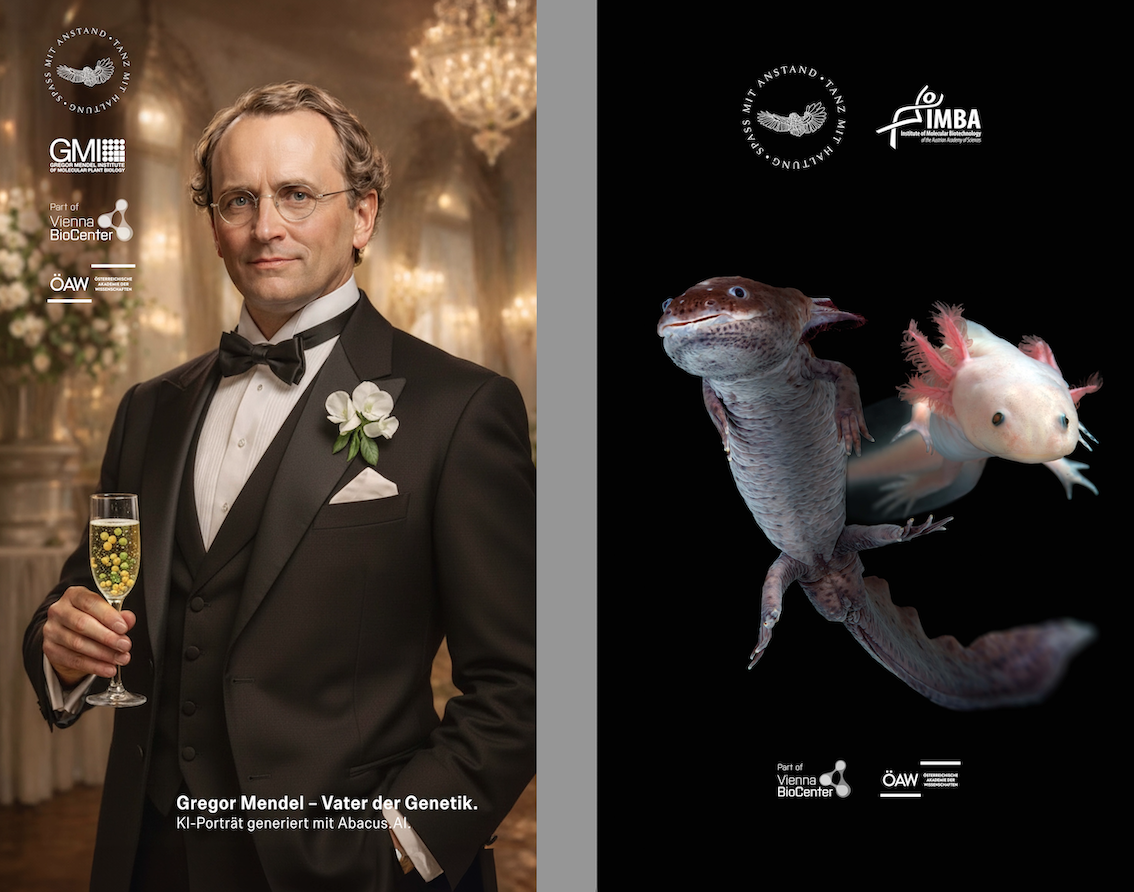
This year’s Science Ball has a fresh new look. A visit with the designers who created the new poster.
Christine Marizzi: Science is everywhere — science is for everyone!
Growing up as a country kid in Carinthia gave me the best foundation for discovering science anytime and anywhere. When I wasn’t playing outside in nature or tending to my garden, I was creating a herbarium or drawing pictures of plants and trees. Continue reading Christine Marizzi: Science is everywhere — science is for everyone!
Ticket go on sale for #SciBall26

For weeks, the organizing committee of the Science Ball has been experiencing extremely high demand from both Austria and abroad. Tickets can now be booked in the online shop. The prices: €150 for regular tickets, €60 for students. Tables can also be booked in the online shop; the boxes are already sold out. Continue reading Ticket go on sale for #SciBall26
Why we are giving ourselves a motto for 2026
“To boldly go where no one has gone before.”
Other balls adopt a motto every year. The Science Ball has always been reluctant in this regard. Firstly, because we on the organising committee wanted to establish a traditional ball from the very beginning, one that would convince by virtue of its mission. The maxim “Fun with decency, dance with attitude” is as true in 2026 as it was at the beginning in 2015. And besides: Does the Opera Ball have a motto that goes beyond the musical program? The Techniker Cercle? Or the Philharmonic Ball? All right, then. Continue reading Why we are giving ourselves a motto for 2026
On the passing of Tom Lehrer
The death of the great Tom Lehrer at the age of 97 is very sad news. The mathematician and songwriter is best known for his song “Elements.” In 2021, in the midst of the coronavirus pandemic, we asked chemist and pianist Nuno Maulide (University of Vienna) to accompany Anne Wieben in her performance of Lehrer’s prophetic “I Got It From Agnes,” in which he explains chains of infection with his trademark blend of science and sarcasm. Continue reading On the passing of Tom Lehrer