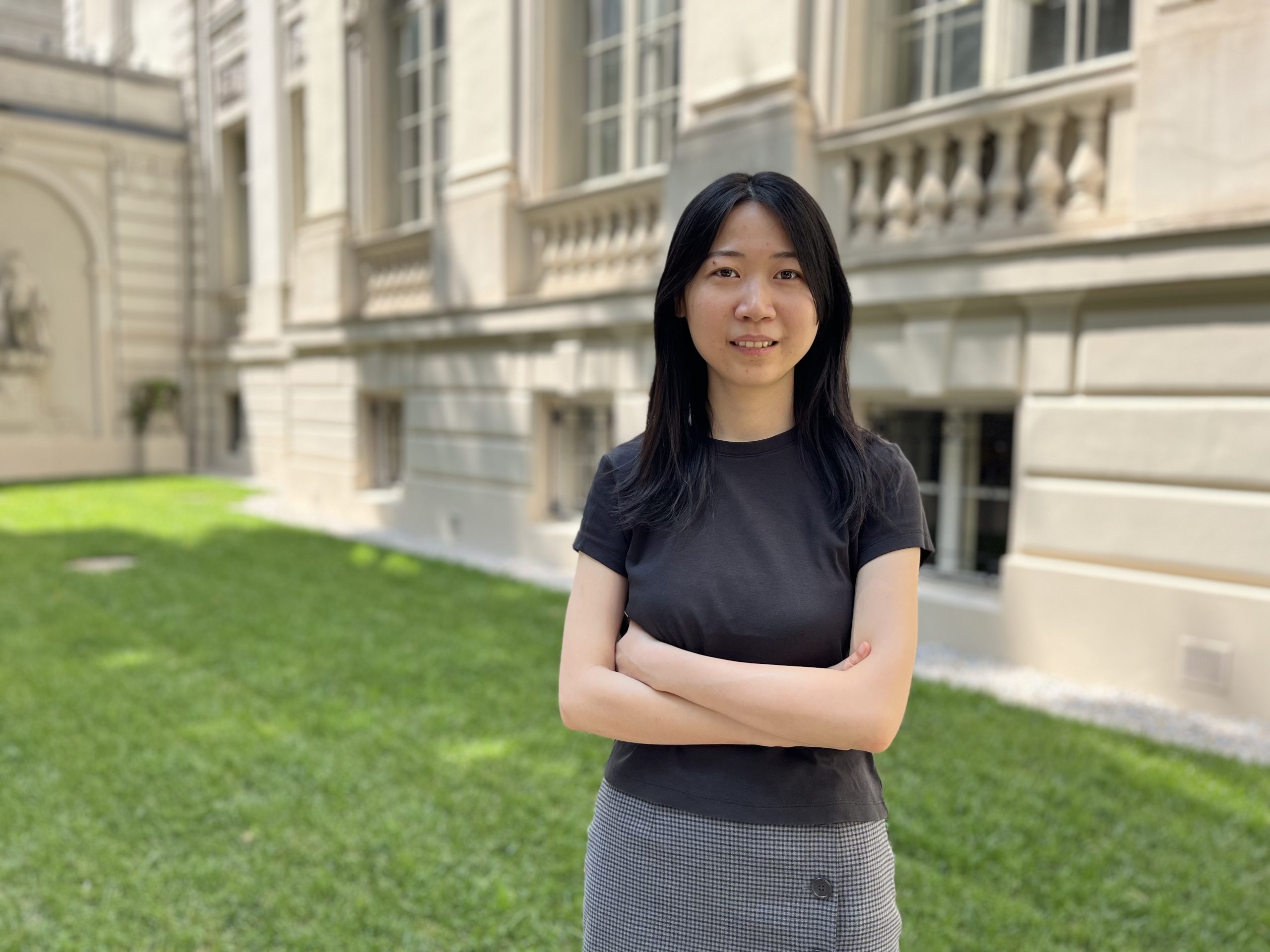
Visualization expert Liuhuaying Yang fills data with sensory experiences – and thus opens up new avenues for science communication. What do agriculture and military technology have in common? Yang compares societies from 10,000 BC to 1800 AD, revealing the driving forces behind increasing social complexity.
Since 2021, Yang has been a driving force at the Complexity Science Hub, where she leads the visualization team and is also a member of the teaching staff. She has contributed to more than 30 visualization projects, which now form important elements of the CSH’s research communication and educational materials. Her portfolio reflects a remarkable thematic range: she created the first “zoonosis network,” which depicts the transmission of 197 pathogens between humans, animals, and the environment over a period of nearly five decades. She mapped global interdependencies in food production and visualized mobility patterns in more than 1,000 cities in over 60 countries, highlighting where the dominance of the car continues and where sustainable alternatives could emerge. In one of her most recent works, she compares societies from 10,000 BC to 1800 AD in terms of their agricultural productivity and advances in military technology—two key drivers of increasing social complexity. This work can also be seen at the 11th Vienna Ball of Sciences.
 The Complexity Science Hub (CSH) is Europe’s scientific center for research into complex systems. It translates data from a range of disciplines—economics, medicine, ecology, social sciences—into applicable solutions for a better world. Founded in 2016, more than 70 scientists are now conducting research at the CSH, driven by the growing need for a sound understanding of the interrelationships that underlie our society – from healthcare to supply chains. With its interdisciplinary methods, the CSH is developing the skills to find answers to today’s and tomorrow’s challenges.