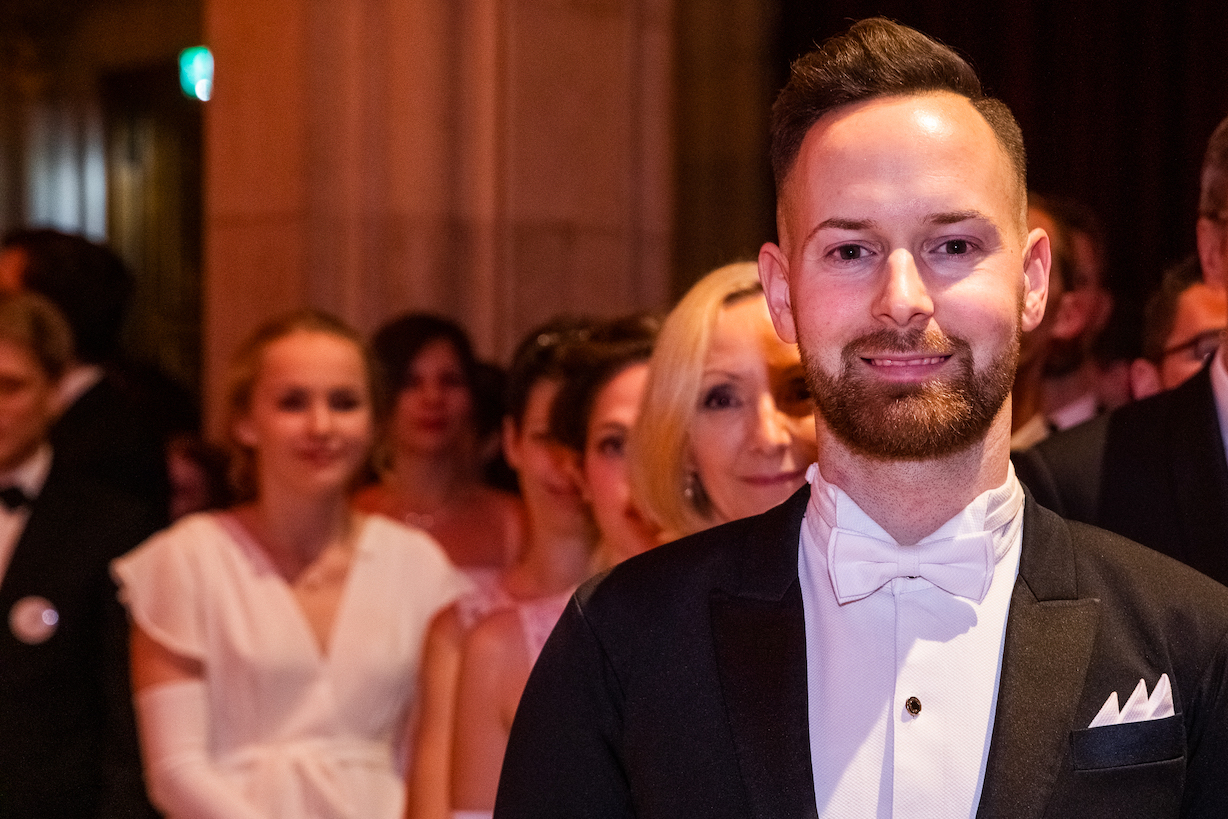
Every year, Florian Vana guides hundreds of couples through what may be the first quadrille of their lives. But this professional dancer has a background in biology. And so, not only dance but also science is very important to him.
The huge chandelier shimmers in pink light. The hall is completely empty. A rare sight: in a few hours, lots of dancing couples will be gliding across the dance floor again. Under the direction of Florian Vana, of course. We are sitting in the ballroom of the Kraml dance school in the 3rd district. Vana is the creative head of this institution.
But since 2018, he has not only been the dance master of the Science Ball. In 2016, he danced his way to the world championship title. In 2017, he followed that up with the European championship title, also in the Disco Fox category. He also swept across the dance floor on “Dancing Stars.” Florian Vana can look back on an eventful career—and that’s just the beginning. He now focuses on teaching. “When teaching adults to dance, you first have to get them to stop thinking. I always make a joke: ‘I don’t care if you understand it. Your body has to experience the sequence of steps once. Florian started dancing at the age of four. It was as much in his blood as science: his mother was a doctor and dancer, his grandfather was concertmaster with the Vienna Philharmonic. Science and dance have a lot in common: “You have to know the rules first in order to break them.”
Vana studied microbiology and almost completed his degree. But combining biology with a dance career was not easy. He decided to focus on the dance floor. “I have the sentimental hope that I might still get my degree.” What fascinates him about microbiology? “That it helps you understand connections and yet is constantly evolving.” He could remain faithful to dancing, but then there’s science: “I don’t know if it will be a lab job under the neon lights. I don’t think my personality is quite suited to lab work.”
The Science Ball is unconventional in many ways, but the dance is intended to add a touch of tradition. “It’s a small nod to Viennese dance culture.” Short quotes from science are a must in the dance. “Once, the dancers formed two intertwined circles in reference to Mendel’s laws.” He sees science communication as a responsibility. “It’s important that someone appears on TV whose scientific explanations make sense. You shouldn’t be too proud to do that.” Children’s programs have special potential: “Passing on science is very important at all levels. If you learn to dance as a child, it’s a very natural way of dealing with things. The same applies to science – and should therefore be encouraged.”