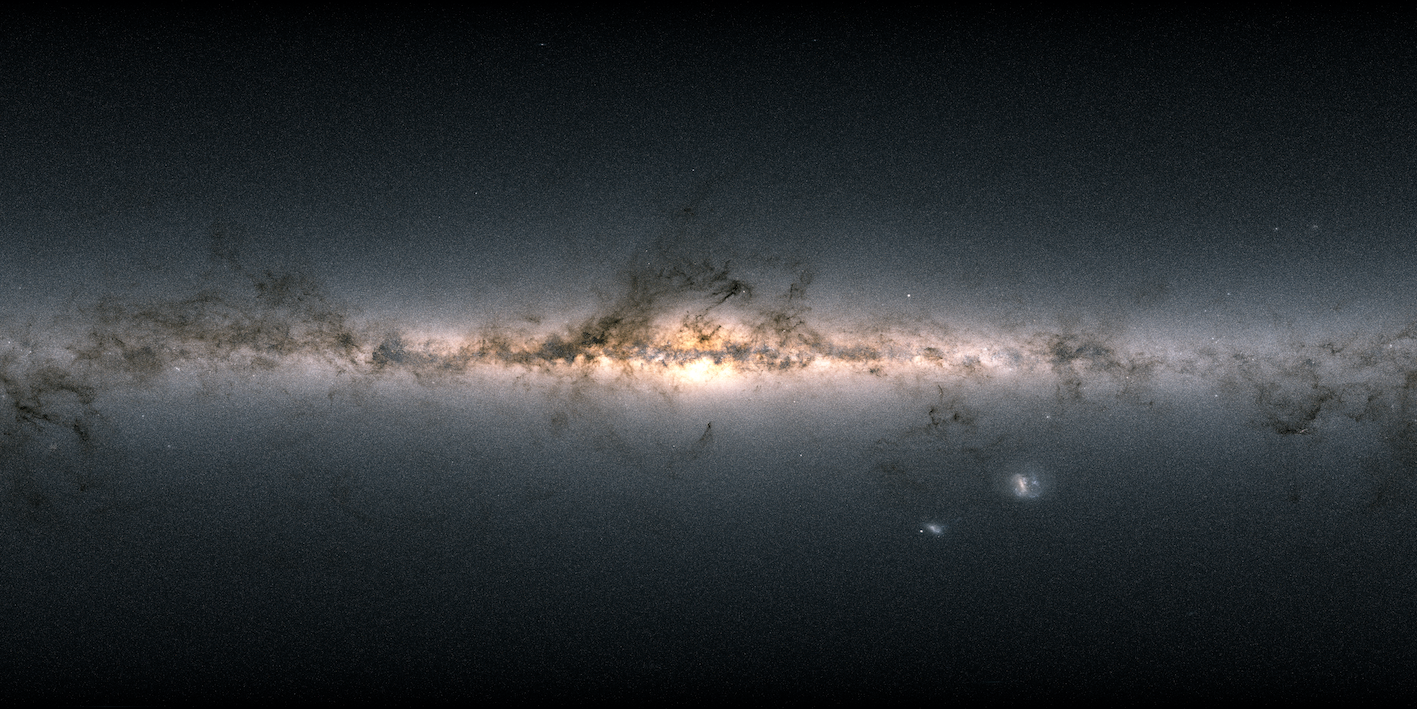
Film premiere at the Science Ball: “Encounters in the Milky Way” from the American Museum of Natural History (AMNH) is a spectacular journey through our galaxy. With Hollywood star Pedro Pascal as narrator.
With 5.4 million visitors, the American Museum of Natural History is the most popular natural history museum in the US and one of the 20 most visited worldwide. And even those who have never been to New York to visit the imposing building in a prime location right next to Central Park may know it from the comedy “Night at the Museum,” in which the skeleton of a Tyrannosaurus rex begs the protagonist Ben Stiller to throw a stick, while Robin Williams as Theodore Roosevelt rushes to his aid on horseback.
 However, the AMNH is much more than a chamber of wonders; it is a research institution with a strong focus on popular science communication. The most recent example of this is “Encounters in the Milky Way” – on display in New York as a projection in the Hayden Observatory and in Europe for the first time at the Science Ball 2026. With spectacular images from the Gaia space probe and the James Webb Space Telescope, simulations on a par with Hollywood productions, and Pedro Pascal as narrator, “Encounters in the Milky Way” tells the story of our solar system’s journey through our galaxy.
 One of the scientific advisors is Santiago Torres, currently a Marie Skłodowska-Curie Fellow and IST-BRIDGE Fellow at the Institute of Science and Technology Austria (ISTA) in Klosterneuburg near Vienna. Torres (seen left) explains his findings and their visualization on the screen: “One of my discoveries, which is presented in the first part of the film, is the idea that interstellar space is not empty, but filled with a diffuse cloud of comets – remnants of planet formation from many systems. These interstellar comets are messengers traveling between the stars, potentially delivering the building blocks of life, much as comets may have done for the early Earth.”
 Torres is in excellent scientific company: the project was realized with significant support from NASA and data from ESA’s Gaia spacecraft. On the occasion of the premiere in New York, exemplary multimedia teaching materials for use in US schools were also published. In Austria, the film is being used at the VISTA Science Experience Center on the ISTA campus in Klosterneuburg.
The Mexican astrophysicist is particularly well-suited to participate in this interdisciplinary project. He has a strong passion for the intersection of science and art and founded the ScienceArt:Collective as a space that connects scientists and artists worldwide.