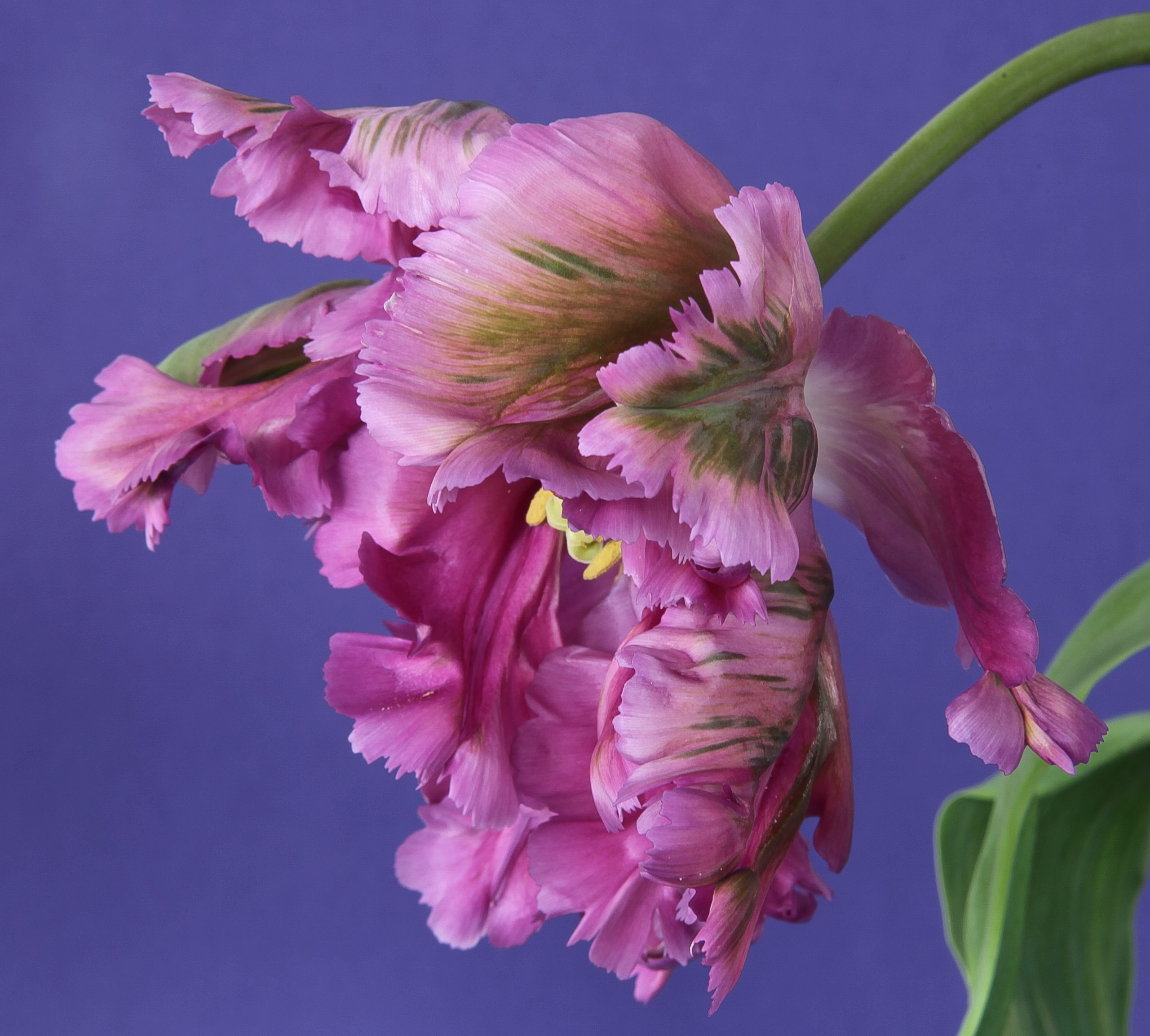
Parrot tulips captivate with their unique beauty: there are virtually no limits to their colors, and the fringed petals resemble the feathers of this magnificent and talkative bird. So indeed, very befitting as this year’s flower decoration at the Science Ball.
Tulips have fascinated people for hundreds of years. Sultan Ahmed III, who ruled the Ottoman Empire in the 17th century, had tiles, carpets, and paintings made with this motif. His enthusiasm was so great that he spent a fortune on tulip bulbs.
Parrot tulips are also a costly affair. If you want to buy its bulbs, you have to dig a little deeper into your pockets than for conventional tulip bulbs. Contrary to popular belief, it did not originate from a virus or a spontaneous mutation, but in 17th-century France from a cross between Darwin tulips – characterized by strong colors and large petals – and late-blooming tulips. Darwin tulips are not related to Charles Darwin, but they owe their name to him.
“Plants as objects of study have a tactical advantage when researching biodiversity – they can’t run away.” Michael Kiehn has been studying them for decades. “Without plants, there is no life. They allow us to study phenomena of evolution,” he affirms. Kiehn is professor emeritus of botany and was director of the Botanical Garden in Vienna for many years.
There is also a lot of superficial knowledge circulating about botany these days. Targeted information is the most effective antidote, says Kiehn: “In recent years, we have seen a very heated debate about non-native species. This inherent xenophobia is being exploited politically.” He continues: “There are many plants that are not native and are excellent sources of food for pollinators and are not invasive. You won’t find anything about this on gardening websites – and that’s a problem. Emotional factors play a role here: no one thinks of tulips as a non-native species.” One thing is certain: even today, tulips have lost none of their fascination.
Text: Flora Neubert